Posts tagged Apple
Pentagon Approved; Samsung Galaxy S4!
May 6th
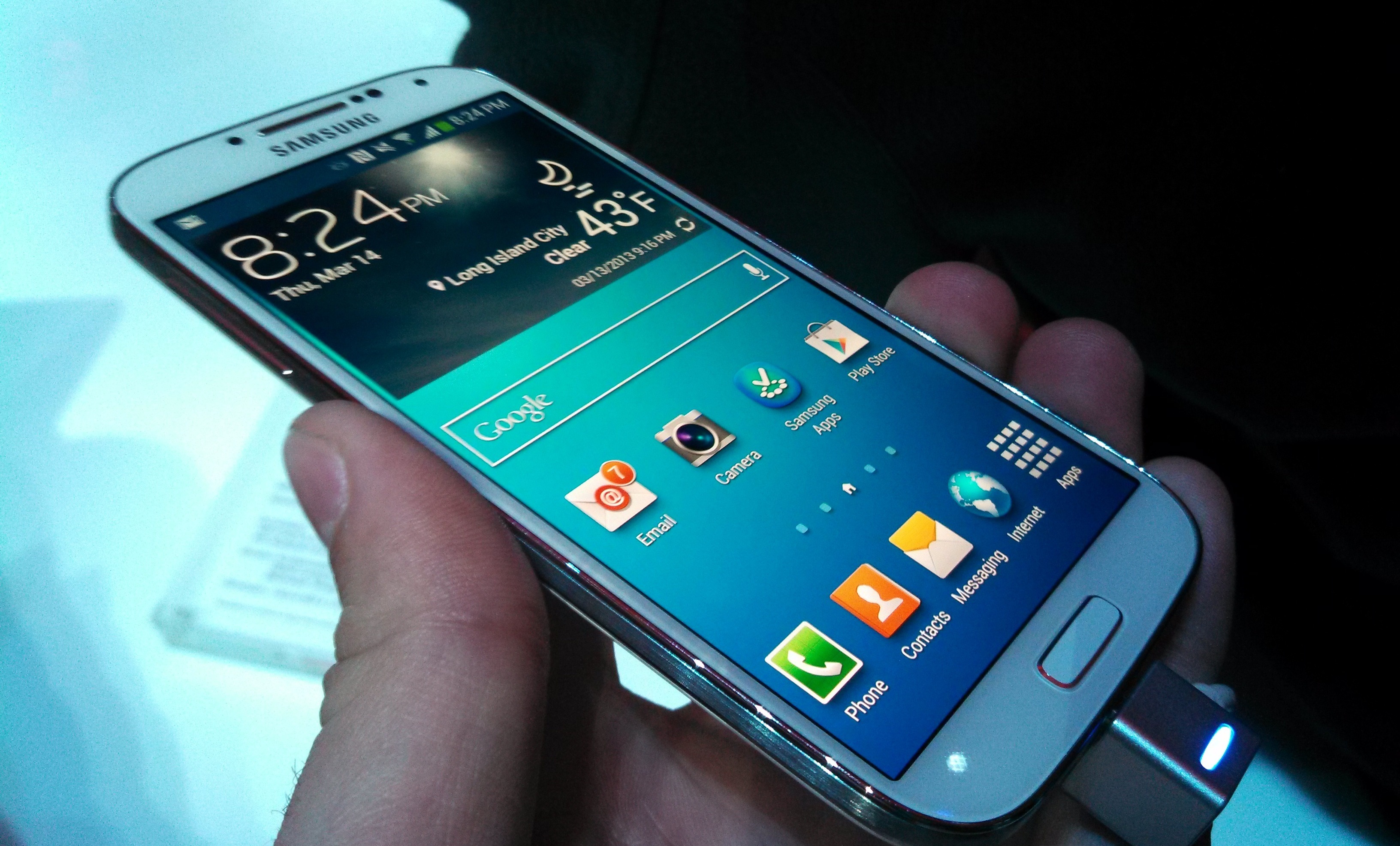
It is official; the US Department of Defense (DoD) has given its approval for the latest Samsung Galaxy S4, making it the company’s very first device to acquire US governmental certification. This ratification also covers Samsung’s Knox security system which facilitates the device to be used as part of a new policy for US government staff, as reported by Korea’s Yonhap News.
This approval is in consonance with a DoD declaration dated from February that will commence its communications networks to Smartphone and tablets from both Apple and Google by February 2014.
Samsung’s endorsement comes merely a day after BlackBerry announced that DoD had approved its latest line of BlackBerry 10 devices as well as its existing line of PlayBook tablets for use. This news served as a thrust for the struggling Canadian device manufacturer, however, it will have to cope with sharing its position in the government with Samsung and Apple; a DoD spokesperson stated the latter’s iPhone and iPad devices ought to receive approval this month.
It was reported earlier that the White House is keen to switch from its armada of BlackBerry Smartphones for a more pliable alternative that allows its employees to choose from Samsung’s Galaxy range, or Apple’s iPhone and iPad products. The fact that Samsung is now certified for use with the Department of Defence is a clear demonstration that the growth of the Korean company and the BYOD (bring your own device) trend has alerted the BlackBerry-Only mentality in the US government.
Samsung is increasing its focus on business and enterprise users – having launched a new global marketing campaign just this week, and it would undoubtedly serve as a major symbolic win if the company were able to make a blister in BlackBerry’s position with the US.
The much anticipated Galaxy S4 was unveiled at a media event in New York back in March. The device was available to customers in 60 countries late last month.
The device is a sequel to the Galaxy S3, which surpassed 40 million channel sales in January of this year. The milestone was in the nick of time; putting Samsung’s Galaxy S series past 100 million channel sales. Yet, this time around, the company is having even bigger hope from the flagship phone, and with the break into the US government, it seems it is on the right track.
Wave goodbye to Gorilla and say hello to Sapphire!
Mar 25th

How many times have you scratched your smartphone’s screen for eternity from a simple drop? And how many times have you been surprised at the high price of this screen? Well, what if we told you there might be a way to ensure your screen is never again vulnerable to such unfortunate events even if it was directly rubbed by a rock? Yes, it might be possible thanks to Sapphire.
The hardest natural substance after diamond, Sapphire, might soon be employed to produce smartphone screens. The military already incorporate sheets of Sapphire glass to produce transparent armors. However, if more Sapphire- synthesizing startups have the green light , this will aid at making Sapphire glass become more mainstream –price wise- and applicable for a variety of consumer products. Smartphones will be the very first example of such products; tablets will soon follow as well as other ruggedized devices.
In case you’re intrigued to find out more about this mystical material we can help you out; Sapphire is a transparent, crystalline for of aluminum oxide (alumina) that is impeccably hard, scratch-resistant, with a melting point of 2,030 c and almost impenetrable to astringent chemicals. To simplify it for you; Sapphire is just modestly weaker and yet a much cheaper and more exuberant version of diamonds. Sapphire proposal ring anyone?
On a more realistic plate, Sapphire is around 10 times more scratch resistant than regular window glass, and considerably stronger than any other materials employed in optics applications. It is this crudeness that has led Sapphire glass to be the key element used in applications where normal glass does not suffice. Bullet-proof glass is a clear example, as well as watches and the front windows on barcode scanners.

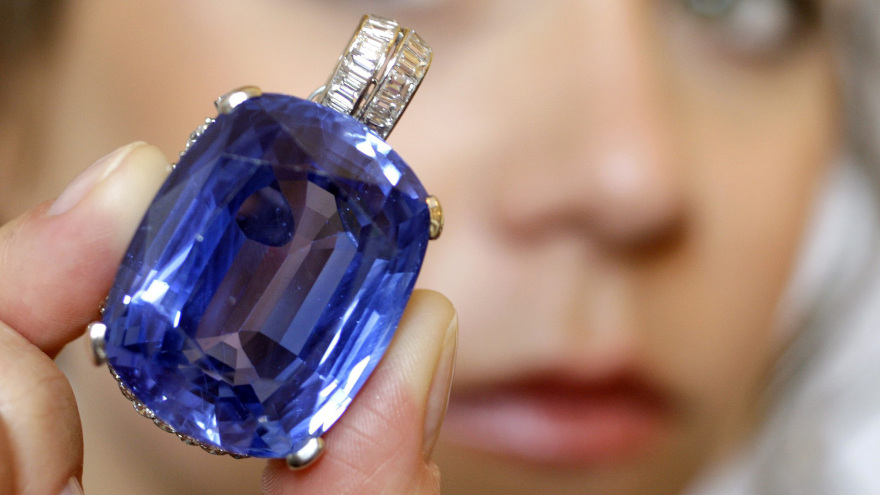
Eminently speaking, synthetic Sapphire is quite easy to manufacture, though the exact processes used are usually proprietary. In general, all it takes is melting a large amount of aluminum oxide in a special furnace, and then allowing it to gradually cool off so as to create a single crystal of flawless Sapphire. A transparent crystal of Sapphire is created by straight-up aluminum oxide. If you’re eager to create a specific gemstone, however, trace minerals ought to be added; titanium and iron create the stereotypical blue Sapphire, while chromium turns it into a ruby. Once you have a big crystal – such as the picture above- a diamond saw is manipulated to slice it into sheets of glass.
With approximately 3 times the strength and scratch resistance of Corning’s Gorilla Glass, Sapphire glass would easily make an ideal smarphone screen. But you can’t have your cake and eat it too, right? According to a market analyst, a sheet of Gorilla Glass costs about $3, whereas the same piece of Sapphire glass would cost $30.
We can thank the increasing competition, though, that is quickly reducing the cost of Sapphire glass. We wouldn’t be taken aback if we were to see a high-end smartphone (such as an iPhone for example) use a Sapphire screen in the upcoming years. It’s note worthy to say that the iPhone 5 already uses Sapphire glass to foster its rear camera lens; Apple is certainly not in the dark when it comes to Sapphire’s potential.
Another alternative would be to create very thin sheets of Sapphire, which are then varnished onta a cheaper material. As reported by Technology Review, GT Advanced Technologies is implementing this idea. Through the acquisition of Twin Greeks’ ios cannon technology, which creates very thin sheets of silicon from a large crystal of silicon for use in solar cells, GT aims to produce sheets of Sapphire that are thinner than a human hair. In the video above, you can witness an iPhone that’s been retrofitted with a sheet of GT’s Sapphire glass – its durability is quite astounding.
Apple releases two new ads you should see today!
Feb 18th
Two new highly vivacious ads have just been released by Apple for the iPad that flaunts some of the 300,000+ apps tailored for its tablet lineup.
The first ad, “Alive”, skims through the adjectives “loud”, “deep” and “alive” to accent and emphasize interactive apps such as GarageBanad, TED and iMovie.
The second commercial, “Together”, accentuates the adjectives “wild”, “bright” and “together”.
The whole campaign is centered towards the fact that the iPad is intended to be used for creative and engaging activities, alternatively to be used just as a passive consumption of content. Despite the early criticism that was targeted at the original iPad; stating it was befitting consumers rather than creators, the versatility of apps in the App Store, including Apple’s very own titles – as iMovie and GarageBand- have proved the allegations wrong.
Apple declared in January that it had sold 22.9 million iPads just in the last quarter. However, its dominance in the tablet area has receded as rivals have soon caught up with their own offers.
For the last post of 2012, we bring you…
Dec 31st

For the last post of 2012, we decided to bring you this year’s top tech failures. No, we are not negative, but we found these 11 to be incredibly hilarious and had to be shared with our beloved readers. So take 10 minutes to reflect on how the tech world changed this year and let us know what your thoughts are and what you expect will happen in 2013.
11. Nexus Q
In a bid to enter the media connection world, Google introduced the Nexus Q. The thing is: it didn’t quiet function; it rather looked like a cannon ball, beside the fact that there are plenty of cheaper substitutes out there with more trustworthiness. They removed it from the shelves almost instantly, my oh my…
10. Airtime
On the release day, this video chat site was the hype. Everyone from Jim Carrey, Jimmy Fallon, Alicia Keys and even Mark Zuckerburg showed up. 30 days later, no one cared anymore. We pity Napster creators; they just cannot seem to get a break!
9, 8 and 7 Facebook, Facebook and yes Facebook.
We do not know where to start naming all the failures of Facebook for this year, so we decided to include at least three. Number 9 goes to Facebook Camera; an Instagram copycat that was rolled out just a month after Facebook purchased Instagram itself. Humm, very intelligent move.
The embarrassing stock plunge lands at number 8. The Facebook IPO did not go quite as planned; in a prophetic moment, the Nasdaq’s software broke down causing a 30 minute delay. This alone ought to have indicated that the stock would turn out to be more of an embarrassment than profit.
If the Facebook Camera and Stock scene were not enough, then the nonsensical chair commercial must win the bet. Being its very first commercial, Facebook certainly made a very bad choice.
Ok enough with Facebook, moving on.
6 & 5 Apple and Apple
It seems even the high roller Apple suffered some tech miscarriages this year. Who can forget the brilliant commercials? Apple seemed to follow in Facebook’s footsteps with the production of a commercial that totally missed the spot and was even offensive to many. However, Apple has a long streak of great marketing so there was no excuse for this one.
Apple’s second failure of 2012 was the unforgettable Apple Maps.
This is a classic scenario of wanting to make a good thing better but ending up making it worse. Everyone was furious with stories of getting lost or bad direction spreading faster than fire through a forest led to an apology in late September and eventually a new Google Map app in early December. We hope Apple learned the lesson, the hard way.
4. Microsoft So.cl
Don’t be misled; that’s supposed to be pronounced “social”. Nothing exciting here, according to its success thus far, it’s just another social media site similar to G+, Facebook, Twitter, Flickr and all the others.
3. New MySpace
All we can say to MySpace is this: every other social network out there has won so just give it up and move on, sorry.
2. Instagram’s Terms of Service
Who would’ve thought that when you put in your TOS that you have the right to use people’s photos however you please it would horribly backfire? Totally unpredictable we know! Well, Instagram has reverted to its original TOS, but they’ve lost the trust and accounts of many ever since.
1. SOPA
No one can forget the awful Stop Online Piracy Act that caused an unprecedented online furry. Many websites, including Reddit, Wikipedia and Google took a harsh stand on January 18, with either posting advocacy messages on their homepage protesting SOPA, or going dark for a few hours. Without the President’s support, or anyone in the entire globe with an Internet connection, SOPA Was indefinitely put off. So the Congress holds the number one slot for this year’s tech flops.
Of course 2012 wasn’t bad, with the introduction of many anticipated gadgets, tablets and much more. But the flops were simply hilarious.
Nexus 4; All the latest and comparisons with the iPhone 5 & Galaxy S3
Oct 31st
With Monday came Google’s official announcement of the LG Nexus 4, yet it did not yield the expected approval from the customers due to the astounding absence of LTE support. Last year’s Nexus model had an LTE variant, making the 3G-only Nexus 4 appear even more so as a relapse.
Google also announce the Nexus 10 tablet, a 3G version of the Nexus 7 and Android 4.2 ; all of which were set to be unveiled at an event in New York but got cancelled due to the unfortunate Hurricane Sandy.
The Google Nexus 4, manufactured by LG, is most certainly an exceptional Android Smartphone, yet the inevitable question on everyone’s mind remains: how does it compare to the major rivals such as the iPhone 5 and Galaxy SIII ? Well, we’ll help you out and compare the specs below.
Display & Dimensions
Despite the general consensus that comes with the name, the Nexus 4 has a 4.7 inch touch-screen, running at a resolution of 1280*720 pixels. This gives the new smartphone a 320 pixels-per-inch (ppi), which comes in very favorably when compared to the iPhone 5’s 4inch 326 ppi Retina display, and definitely beats the Galaxy SIII’s 4.8 inch 306 ppi display.
Now let’s move to the dimensions; 134mm * 69mm * 9mm and weighs in at 139g, making it larger and heavier than the iPhone 5. This, however, does not come as a surprise thanks to the larger screen-size and the higher capacity 2100 mAH battery. A more object comparison would be with the Galaxy SIII since it is just slightly thicker and heavier.
Power & Features
Google is keen to roll each and every one of its devices with impeccable amount of power, and the new Nexus 4 is no exception. The smartphone boasts a quad-core 1.5 Ghz Snapdragon, S4 processor and 2GB of RAM, easily giving it the upper hand over both the iPhone ( dual-core A6 processor & 1GB of RAM) and the Galaxy SIII ( 1.4 Ghz quad-core processor & 1GB of RAM).
When it comes to Kodak moments, the three smartphones rank pretty much equally; the Nexus 4 has an 8 mega-pixel rear facing camera & a 1.3 mp front-facing clicker for those video calls. The iPhone, similarly, has an 8 mp and 1.2 mp, the Galaxy SIII has an 8 mp and 1.9 mp.
The one major advantage the Nexus 4 can boast over its two major rivals is its unprecedented wireless charging, which is not supported on both the iPhone 5 and Galaxy SIII. The wireless charging mat comes included in the retail box, hence saving you the burden of buying an extra accessory that would’ve been exploited had it been Apple’s.
Operating System
The very latest version of the Android Jelly Bean OS, the Android 4.2, is the one implemented in the Nexus 4. The new OS comes with a lot of new enhancements such as the Photo Sphere, an improved version of Google Now and Gesture Typing.
Apple’s latest flagship runs on their latest OS; the iOS 6, while the Galaxy SIII is a step behind the Nexus 4 since it runs on the “oh so last month’s Jelly Bean” 4.1. Not to sound so harsh, the GSIII will be updated surly in the near future, yet the fact that the Nexus 4 comes preinstalled with the latest version still gives it the upper hand.
Lack of 4G & microSD support
We’ve always been taught that all that shines is not gold, and this is true for the Nexus 4 for it does not impress in every category; astoundingly it lacks support for 4G LTE, as well as the lack of support for microSD cards, obliging you to be content with either 8 or 16 GB of existing memory. Of course, this might not satisfy many hungry GB consuming users, but they’ll have to make do with the cloud-based storage. Both the iPhone 5 and Galaxy SIII come in at 16, 32 and 64 models, with Samsung’s support for microSD cards.
Conclusion
To sum it all up for the non tech savvy; the Google Nexus 4 is a compelling smartphone, offers an equivalent display, competitive battery and almost duplicate cameras as its major rivals. It runs on the latest Android OS with the only setback being the lack of support for the 4G and microSD cards. However, this setback is trivial when you take into consideration the pricing; the Nexus 4 is almost half the price of the iPhone 5 and over $160 cheaper than the precious Galaxy SIII. Those who are content with just 8GB of memory can even boast an even greater deal and pay a mere $386.8 for such a great power-packed Droid.
Be part of the smart crowd and download G Cloud today; it’s free!
Mind over matter; use mind-computing on your iPad!
Oct 22nd
InteraXon wants to get into our brains and get in on all the juicy details that go on there; well, maybe not all the details just certain signals they need to transform into actual data that benefit developers in creating new apps that you can control with your mind.
A little too Star Trek for your taste? Well, we thought so too until we comprehended the technology behind it. Apparently our neurons, the brain cells, have happy feet and like to keep on dancing with electrical potentials that spark, dwindle and drift. If these little neurons dance on their own, then they are very quiet, however if thousands or better yet millions join in on the performance in harmony, then the generated noise can be loud enough for sensors to detect. The humongous neuronal dance parties are yes you guessed it brain rave, ops no, they’re brain waves!
Day or night, awake or asleep; these waves of activity are generated by our brains every moment of our life. This is not new, for scientists have been implementing this technology for over a century, calling it EEG (electroencephalography).
Ostensibly, researchers have concluded that different mental states result in different wave patterns; relaxed states result in gentle, slow-moving alpha wave, while immense concentration results in generating quick jagged beta waves.
InteraXon employs this in their attempts to produce a refined new technology; their latest is a wearable headband called the Muse that works on algorithms that detect these subtle changes in our brain and then showcases them in real time.
All this sounds like rainbows and butterflies doesn’t it? Well, given that the technology can transcend to the point where it’s both compatible for both the developers and users alike. Nevertheless, users will have to undergo a learning procedure, so that “signaling” with their brain becomes second nature.
The company’s target is to raise $150.000 through IndieGoGo, a crowd financing website, through auctioning its head units at a discount rate. First ones to jump on the sci-fi ship will enjoy a preorder rate that will ship for $135, while the price will go up to $200 as a final retail price tag.
Apple made the touch mainstream, Microsoft made voice and motion control conventional with Kinect. What’s next? Squinting until you unlock your screen!
Be part of the smart crowd and download G Cloud today; it’s free!
Finger swiping passwords instead of passcodes?
Oct 17th
Apple enthusiasts probably already have their dates set for October 23rd, 10 am PST, San Jose. As the invitations state: “We’ve got a little more to show you”, indicating the rumored iPad mini release. We thought instead of covering a load of prospected features, we’d cover something a bit more interesting yet still iPad related.
Take a minute, meditate and imagine holding your hand open, touching your fingertips to the iPad’s surface, then drawing your fingers together until they meet in the center. Why would you do that you ask? Well, it might be a new method of unlocking your beloved iPad! Yes, according to a new iPad app developed by Napa computer science student Sae-Bae, the new app can analyze the method implemented to perform the gesture; the speed of the swipe, the angles between each fingertip, and then decided to let her use the tablet. If all of these are in cohesion, then a yellow smiley face turns up stating that you could access the app.
The new app is even more intelligent that one might think; if you thought of simply dragging your fingers along the same lines so as to gain access then you are mistaken. Even if two people do have similar hand sizes and speed, the paths will undoubtedly feel unnatural hence resulting in a green frowning face indicating you are locked out.
Sae-Bae, the doctorial student at the Polytechnic institute of New York University, after conducting two recent studies, has come to the resolution has apps like these could be considered as more secure, easier to memorize and more playful alternatives to passcodes as well as passwords. Even though Sae-Bae’s work is still in its infant stages, her adviser and her, dream of a future where gestures and swipes will prove to be a better crafter alternative tailor made for the touch screen age.
Explain to me; how does this work?
Individuals differ in the way they pinch, swipe and even turn, as Sae-Bae explains, so even if someone wanted to copy your gesture, they wouldn’t be able to due to the reasons aforementioned plus add to that the different fingertip distances and speed of swiping.
Another interesting finding was presented by Sae-Bae in May at an Association for Computing Machinery conference. For that particular study, Sae-Bae brought in volunteers who had to make 22 gestures on an iPad and then rate which was the most fun to make. Surprisingly, the most fun ones turned out to be the most secure as well; a finding that is quite the opposite of what happens when compared to text passwords.
Though these series of studies and findings are very interesting, the future is still a little hazy and a lot more test ought to be done. First of which is researching the difficulty of remembering the gestures that one chooses as a replacement to the passcode. What benefit would all of this be if we cannot actually remember what gesture we set?
Be part of the smart crowd and download G Cloud today; it’s free!
Google Maps; More than a map?
Oct 8th
Google must be really proud; after the huge failure of iOS6 maps, it announced last week that 800,000 websites and apps are in fact actively using its Google Maps API. To commemorate this achievement, the search behemoth launched MoreThanAMap.com which demonstrates how developers are leveraging the features of the Maps API.
Even though millions of users use maps.google.com to find where they ought to go, many others also use Google Maps through other sites. Google wants to pay tribute to the developers that use the API, and it’s doing so by showing the visitors of www.morethanamap.com just how Web and App developers effectuate Google Maps features such as Street View, public transit directions, location data, and advanced data visualization capabilities.
There are tons of interactive demos on the website to flaunt the simplicity in which anyone can embed the aforementioned features. Stories are also included especially from those in the community who are using the API to start off businesses, help enhance their communities, or save the environment. In fact, starting this Monday, such inspiring stories will be featured on a weekly basis on the Geo Developers Blog.
Of course no new Google announcement would be complete without a YouTube video explaining the campaign. Google Maps team member Carlos Cuesta, with just a backpack and a camera, spoke to six distinct developers around the world about the API:
Do not be mistaken: this marketing move is not out of place. Despite Apple’s open apology for iOS 6 Maps, Mountain view was also criticized for not working something out with Cupertino, as well as for not releasing a standalone Maps app in time for the release of iOS 6.
Google is trying to spin off the whole situation for its favor, and making it look like it’s the victim. If we think about it, 800,000 sites and apps is not such a huge turning point; no big deal was held for the 600,000 mark, and there certainly was no new website launched to flaunt how the whole world is using its API.
This is the embedded message that Google is trying to get through: “Check out all the developers that already enjoy having thriving businesses based on our API. Yes, we’ll release a Google Maps app for iOS 6 when time is right, but until then, check out what Apple and its fanboys are missing out on.”
Be part of the smart crowd and download G Cloud today; it’s free!
The iPad; did Steve Jobs start working on it in the 80s?
Oct 3rd
It’s almost been a year since Steve Jobs passed away and yet his legacy will surly live on for centuries to come, and debates over his unprecedented foresight will be the topic of many articles to come. One particular talk he gave back in 1983 at the Center for Design Innovation has received a lot of interest.
That specific talk compromised a ton variety of topics that ranged from wireless computing to the project that would become Google StreetView. Yet, an intriguing new discovery of an original cassette tape of that speech has added a spicy spin plus an additional 30 minutes or so of Q&A after the actual main talk.
The topics discussed are quite mesmerizing. One of which was computer networking; a notion that would lead to the App Store, and better yet, this notion would lead to the discovery that Apple has started creative work on the well-recognized iPad- yes 27 years prior to its release.
Steve was inquired as to how computers would all work together, and he gave glimpses of the inevitability of a universal networking standard that allows them all to communicate.
Here are a few of the most memorable things Steve mentioned in this amazing talk:
The personal computer is tackled as being a new medium of communication. Bear in mind, this was in a time when networking was not yet conventional nor was the Internet as widespread as it is now. Still, Steve talks in grave precision about early e-mail systems and how it reframes communication. He states, back in 1983, the idea of walking around anywhere and receiving e-mails; 20 years ahead of the mobile computing.
An experiment done by MIT is mentioned, one that resonates a lot like the Google StreetView application.
Early networking is discussed and the problems of different protocols that existed then. He gave predictions about solving the networking problems at the office and at home, giving an estimated of 5 years for the former and 10-15 years for the latter. He was spot on.
An early Apple strategy is put forth and discussed, stating that it is Apple’s mission to “put an incredibly great computer in a book that you can carry around with you that you can learn how to use in 20 minutes”. Oh, can you relate this to anything you are using today? We bet you do, and oh they also wanted to do so with a “radio link” to ensure people would not be required to hook it up to anything to communicate with “larger databases” and other computers. Insightful!
A question is raised, just at the end of the Q&A session, around the voice recognition, a notion that was about a decade away from realization. When linking Siri to his talk that day, it’s insightful to hear what Steve had to say about that technology then and there; he mentioned the difficulty he faced of recognizing language vs voice since language is contextually driven.
So finally, here is the recording of the talk from the 1983 IDCA. The formerly unavailable Q&A session begins at around 21:30 of the recording. Please be noted that the majority of the questions posed by the audience are incomprehensible, yet Jobs’ responses give meaning to them.
Be part of the smart crowd and download G Cloud today; it’s free!
“The iOS 6 Maps are Amazing. Not”
Sep 24th
This past week or so, we’ve been bombarded with Apple news everywhere, whether we are Apple fanatic or not, we had to listen. Yet, yesterday, it was not all sunshine and rainbows for the Tech Giant for it faced major ridicule due to its ill-performing new maps tool.
The tech behemoth abandoned Google maps and replaced it with its very own Maps App, one that operates through the usage of data that is provided by navigation systems such as Tom Tom. Yet, it seems that Apple was too quick to launch the App for users were quick to notice the many ways the company erred.
Ireland’s very own Minister for Justice, Alan Shatter, voiced his dissatisfaction with the iOS 6 system that placed an airfield in the middle of a city farm.
The 3D function also hit many faulty notes such as misplacing many well-known landmarks, placing streets over bodies of water, not to mention the foggy, distorted images.
Disappointed iPhone users were quick to share their horrific experiences by uploading their ‘map fails’ onto a Tumblr blog, which quite bluntly declare “The Apple iOS 6 Maps are amazing. Not.”
The conversation has been so viral that it became trending on Twitter with tons of dissatisfied users sharing ways of reverting to the preceding Google maps function.
Tom Tom clearly dissociated itself from the faulty App, stating it solely provided Apple with the data and was in no way responsible for how that data was used.
A spokesman justified the malfunction saying that the user experience will be enhanced once more users will start to contribute as well as adding additional features such as visual imagery.
“We are confident about our map quality, as selling 65 million portable navigation devices across the world and more than 1.4m TomTom apps for iPhone in the past two years reaffirms this quality.”
In addition to Maps, Apple has also decided to abandon its native YouTube App. A dedicated YouTube App was instantly released and surly enough, performed considerably better than its predecessor.
Well, facts are facts, and Google has a record of more than 7 years in the business of digital mapping, a period that has allowed for them to build a substantial amount of invaluable data. Apple is surly mislead if it thinks they will come even close in the next year or years. Rumor has it, that Google Maps is working on an iOS dedicated app and is just pending Apple’s approval; we don’t know about you but we’re not too keen on Apple’s approval.
Be part of the smart crowd and download G Cloud today; it’s free!