BigMIND Cybersecurity Reset for 2026: Secure Your Home Office the Smart Way

As remote and hybrid work continue to dominate modern workflows, cybersecurity has become a personal responsibility—not just an IT concern. In 2026, home offices are prime targets for ransomware, phishing, account takeovers, and accidental data loss. According to IBM’s Cost of a Data Breach Report, human error and compromised credentials remain among the leading causes of breaches, with remote work environments amplifying the risk.
This is why many professionals are starting the year with a Home Office Security Reset—a structured approach to protecting devices, identities, and data. With BigMIND, users can adopt safer digital habits through zero-knowledge encryption, multi-device backups, and advanced monitoring—without adding operational complexity.
Why a Home Office Security Reset Matters in 2026
Home offices now store sensitive business files, personal documents, financial records, and intellectual property—often on multiple devices and networks. Unlike corporate environments, these setups usually lack centralized IT oversight.
Recent industry findings highlight the urgency:
- Over 80% of breaches involve compromised credentials or phishing.
- Ransomware attacks continue to grow year over year, increasingly targeting individuals and small teams.
- Data loss from device theft, hardware failure, or accidental deletion remains a top productivity risk.
A cybersecurity reset focuses on prevention, resilience, and recovery—ensuring that even if something goes wrong, your data remains protected and recoverable.
Step 1: Eliminate Single Points of Failure with Multi-Device Backups
Modern work is inherently multi-device: laptops, desktops, external drives, NAS systems, and smartphones all contain critical data. Relying on a single device—or a single copy of data—creates unnecessary risk.
BigMIND enables secure backups from:
- Internal and external drives, and network locations
- Mobile devices (iOS and Android)
- Remote and hybrid workstations
Incremental and block-level technologies ensure that only changed data is transmitted, reducing bandwidth usage while keeping backups continuously up to date. This approach aligns with industry-recommended 3-2-1 backup strategies, widely endorsed by cybersecurity authorities.
Step 2: Protect Privacy with Zero-Knowledge Encryption
One of the most overlooked aspects of cybersecurity is data privacy at rest. Many cloud services can technically access user data, which introduces compliance and trust concerns.
BigMIND uses zero-knowledge encryption, meaning:
- Encryption occurs before data leaves your device
- Only you control the encryption key
- No administrator, third party, or service provider can view your files
This architecture is critical for professionals handling regulated or confidential data and aligns with globally recognized security frameworks such as ISO/IEC 27001.
🔗 Permissions, Privacy, and Security
Step 3: Strengthen Access Controls and Account Hygiene
A security reset is incomplete without reviewing account access. Weak passwords, unused accounts, and outdated permissions are common entry points for attackers.
Best practices supported by BigMIND include:
- Secure password recovery workflows
- Role-based access and administrative privileges
- Centralized account and billing management
- Clear separation between users, computers, servers, and policies
By maintaining strict access governance, users reduce exposure to insider threats and unauthorized activity—key pillars of modern cybersecurity strategy.
Step 4: Monitor, Audit, and Detect Early
Cybersecurity is not static. Continuous visibility is essential for identifying anomalies before they escalate.
BigMIND provides:
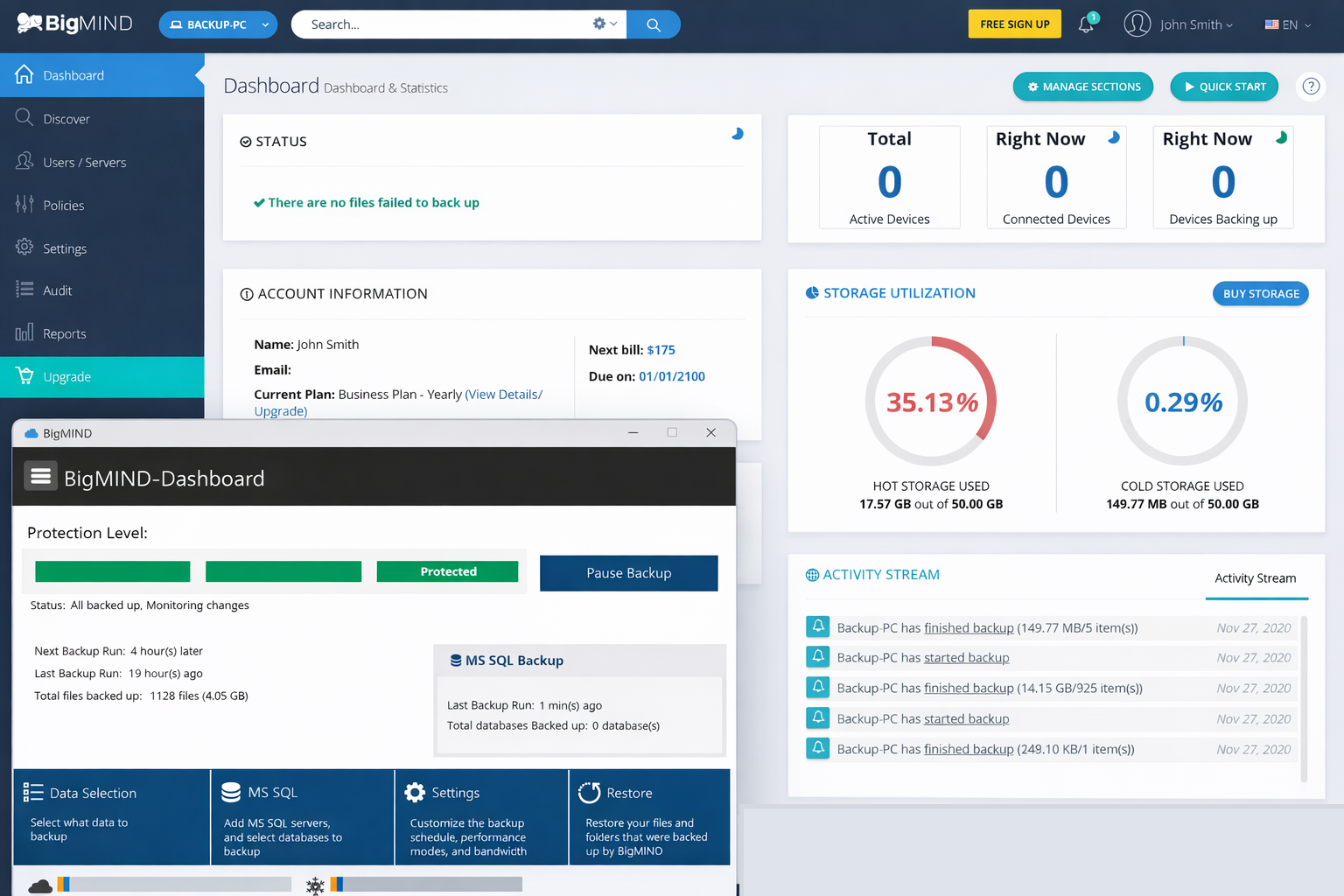
- Backup activity monitoring and audit reporting
- File versioning and historical recovery points
- Alerts for missed backups or storage thresholds
- Intelligent data handling with deduplication and compression
In real-world scenarios, these capabilities have helped users rapidly recover from ransomware incidents by restoring clean file versions—without paying ransoms or losing productivity.
Step 5: Secure AI-Assisted Organization and Discovery
As data volumes grow, visibility becomes a security concern. BigMIND’s AI-powered features—such as facial recognition and intelligent tagging—help users quickly locate sensitive or important files.
This reduces:
- Accidental data exposure
- Time spent searching across devices
- Risk of deleting or misplacing critical information
Organized data is safer data—an often-ignored principle in cybersecurity planning.
Start the Year Secure, Not Stressed
A Home Office Security Reset is not about adding tools—it is about simplifying protection while increasing resilience. BigMIND consolidates backup, encryption, monitoring, and recovery into a single, secure platform designed for modern work.

BigMIND vs. Traditional Home Office Security Approaches
| Traditional Approach | BigMIND Advantage |
|---|---|
| Manual backups | Automated, policy-based backups |
| Single-device focus | True multi-device protection |
| Provider-accessible data | Zero-knowledge encryption |
| Limited visibility | Monitoring, audit, and reporting |
| Reactive recovery | Proactive resilience |
Frequently Asked Questions (FAQ)
❓How does BigMIND improve home office cybersecurity?
BigMIND combines zero-knowledge encryption, automated backups, monitoring, and secure recovery to protect data against breaches, ransomware, and accidental loss.
❓ Is BigMIND suitable for remote and hybrid workers?
Yes. BigMIND is designed specifically for multi-device, remote, and distributed work environments.
❓What happens if my device is lost or infected?
You can restore clean versions of your data from the cloud to a new or sanitized device, minimizing downtime.
Final Thoughts: Make Cybersecurity a Habit in 2026
Cyber threats will continue to evolve, but strong fundamentals—backup, encryption, access control, and monitoring—remain the most effective defense. A Home Office Security Reset powered by BigMIND ensures that your data, privacy, and productivity are protected all year long.
